
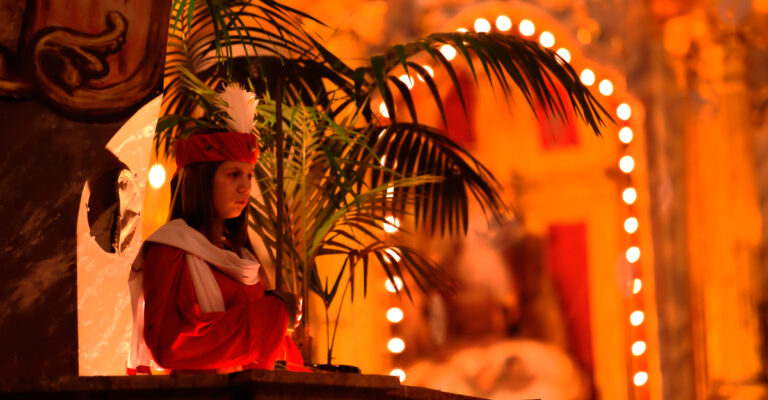
Christmas in Mallorca is full of local authentic tradition. One prime example is on Christmas Eve, when the Sibyl·la is sung to warn of the Last Judgement. It is an ancient prophecy—in the form of song—of the coming of the Son of God. Thanks to the popularity and authenticity of the whole ensemble, the Sibyl·la was added to the representative list of UNESCO’s Intangible Heritage in November 2010.
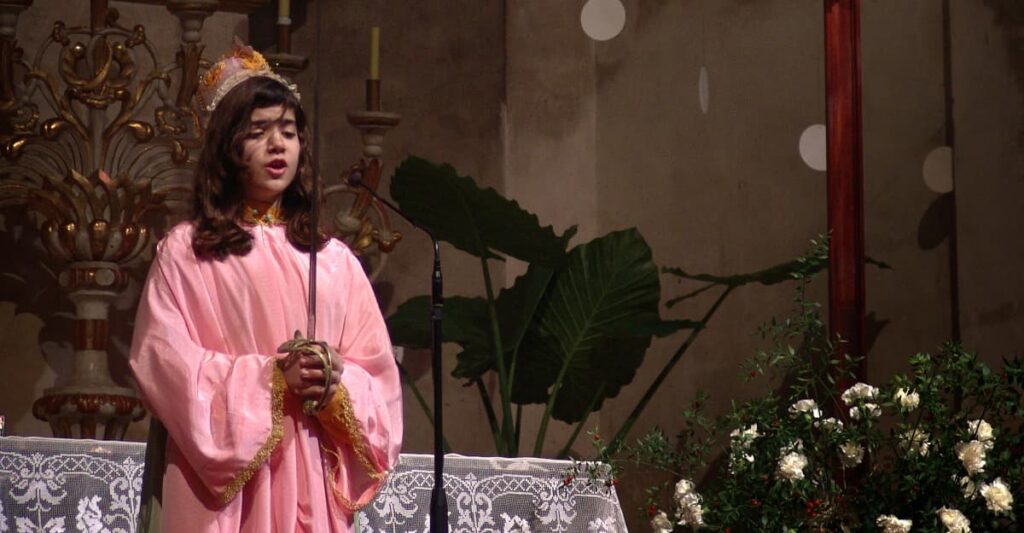
History of the Sibyl·la
The Sibyl·la is a song of medieval origin that forms part of the Christmas Mass and has only survived in Mallorca and Alghero. It was one of the medieval Christmas dramatisations that took root the mainly on the peninsula, especially in Catalonia, from where it arrived in Mallorca after the conquest of James I.
In medieval Europe, many liturgical celebrations were accompanied by representations and dramas of an educational and moral nature to make them more understandable to the people, especially during the Christmas and Easter cycles. Over the centuries, these representations evolved, until the Church stopped considering them useful and expressly prohibited them. But some have passed down to us, albeit evolved in form, such as the representations of the Passion and the Pastorets (shepherds).
The song of the Sibyl·la, of which various manuscripts from the 10th century are preserved, was performed throughout the peninsula until the prohibitions period. Afterwards, it has only survived in Mallorca and Alghero (Sardinia, Italy) and a few Catalan churches on the mainland, becoming one of the few living examples of religious folklore expressions of medieval origin. Today it is one of the most traditional features of Christmas celebrations on Mallorca.
The song is actually from a poem about the final judgement, the Judicii Signum, which reproduced the prophecies of the Sibyl·la of Eritrea. The Latin text was included in a sermon entitled Contra iudaeos, and read at Christmas Mass.
The Sibyl·la gave a long oracle that prophesied the coming of Jesus Christ as judge and described the terrible events of the coming of the end of the world. The description could be long, with a procession, or short, with only the singing of the Sibyl·la, which could be sung in Latin or Catalan, by the priests or by a child.
In 1967, with the reform of the Second Vatican Council, the singing of the Sibyl·la returned to its natural place, the liturgy of Christmas Eve.
The Sibyl·la Today
In ancient times, the Sibyl’s song was sung by priests, who over the centuries were replaced by a boy singer. Today, in most churches in Mallorca it is now a boy, girl or woman who sings the chant.
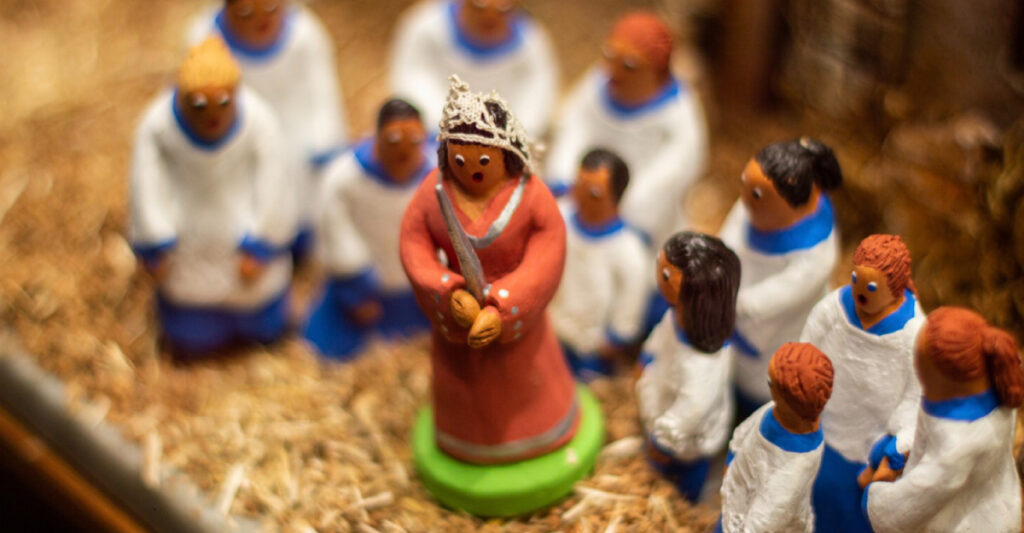
The singer goes out to the presbytery or pulpit accompanied by two or more altar boys with candles. S/he sings the verses without instrumental accompaniment – between verses the organ is introduced. S/he is usually dressed in a white or coloured tunic, sometimes embroidered at the neck and bottom, and a cape; in some villages, the cape is replaced by another tunic. The head is covered with a cap of the same colour as the dress.
In their hands, the singer carries a sword that is held out straight in front of the face for the duration of the song; when finished, the singer forms a cross in the air with the sword. At some celebrations, when the singing ends, a cake hanging from the sounding board of the pulpit is cut with the sword. In the old days, the neules that usually decorate churches at Christmas were cut.
The Music & Lyrics
Originally, the Sibyl·la was sung as a Gregorian melody, and this must have been the case until the 16th or 17th century. The musical accompaniment that was performed in Mallorca, except for some variations, was the same as that documented in other places on the peninsula.
The oral transmission of the song over the centuries led, as with the text, to the appearance of different versions. In the 19th century, the song aroused interest among music scholars and folklorists, which led to the transcription of the different known versions into sheet music. This is how the melodies that have survived to this day were established.
Today, all the musical versions of the Sibyl·la song that are performed have as a common origin the scores established in the 19th century.
The Sibyl song appears documented from the 10th century in Catalonia, Italy, Castile and France. Although it was initially sung in Latin, from the 13th century onwards there are already versions in Catalan, all coming from an adaptation of Provençal origin. Among these versions there is a 14th century codex from the convent of Santa Magdalena, which is preserved in the Diocesan Archive of Mallorca.
Oral transmission and the lack of manuscripts have meant that over the centuries the ancient texts have undergone modifications and have given rise to many versions. The most representative and meaningful text in the current liturgy is the following (**WARNING, it’s pretty bleak**):
The day of judgment
for those who have done service.
Jesus Christ, universal King,
man and eternal God
will come from heaven to judge
and each one will give what is just.
Great fire descends from heaven;
sea, fountains and rivers, everything will burn.
The fish will give great cries
Losing the natural delights.
Before the Judgment the Antichrist will come
and will torment the whole world,
and will act as God to serve
and whoever does not believe him will kill.
His reign will be very brief;
at that time, those two saints, Elijah and Enoch, will die as martyrs all in one place.
The sun will lose its clarity
showing itself dark and cloudy,
the moon will not give clarity
and the whole world will be sad.
To the evils he will say very gratefully:
– Go, damned, into torment!
go, go to eternal fire
with his prince of hell.
To the good he will say: – Come, my children!
Blessed is
the kingdom that is equal
as soon as the world was created.
O humble Virgin!
Jesus Child tonight,
I wish to pray to your Son
that he may save us from hell.
On the day of judgment
for those who have done service.
Intangible Heritage of Humanity
The presence of the Sibyl’s song in the churches of Mallorca at Christmas Mass since the conquest – except for the years 1572-1575, when it was no longer sung in the cathedral – is one of the few living examples of medieval religious folklore.
Many scholars of Mallorcan music consider the song to be one of the most unique and relevant phenomena, due to the convergence of popular tradition and classical music. Also because it constitutes a unique example in which to see the different musical practices that have occurred over the centuries.
The uniqueness and relevance of the Sibyl·la’s song within the collective imagination of the Mallorcans, its character as a ritual representation linked to a time (Christmas) and a territory (Mallorca), as well as its unique characteristics, make it worthy, by virtue of Law 12/1998 of December 21 of the Historical Heritage of the Balearic Islands, of individual protection, that of a cultural asset by declaration of December 13, 2004 (BOIB 25, February 15, 2005 and BOE 60, March 11, 2005).
On November 16, 2010, UNESCO decided, during the fifth session of the Intergovernmental Committee for the Safeguarding of the Intangible Cultural Heritage held in Nairobi, to include the Sibyl·la’s Song in its Representative List. Since then it has been part of the intangible heritage of humanity.